South Asia’s $10 Billion Foreign Exchange Crisis: Why Global Bank Account Verification is the Sovereign Shield
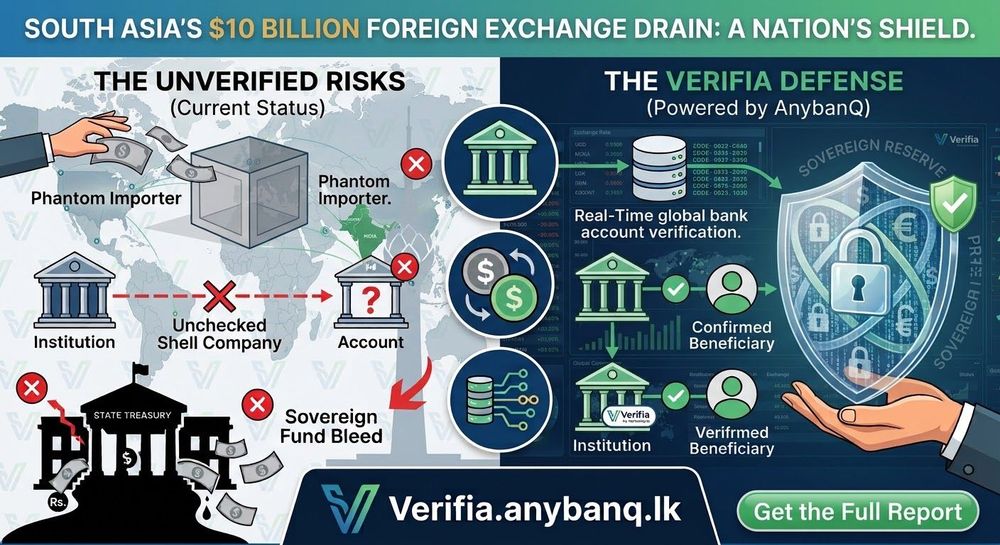
South Asia is facing an unprecedented financial drain, with Sri Lanka and the Maldives serving as ground zero for a devastating wave of capital flight, trade-based money laundering, and cross-border payment fraud.
In Sri Lanka alone, law enforcement and financial intelligence investigations revealed a massive money-laundering network that siphoned approximately $715 million to $1 billion out of the domestic economy. The operation relied on an intricate web of 105 shell companies, over 200 bank accounts across 13 major commercial institutions, and tens of thousands of fraudulent Telegraphic Transfers (TTs).
Using fake proforma invoices for phantom imports—ranging from pharmaceuticals to essential goods—fraudsters exploited advance TT facilities to wire hundreds of millions in foreign currency directly out of the country. Not a single physical good ever entered port.
This multi-million-dollar capital drain represents a systemic attack on national stability. And the primary flaw exploited across every transaction remains simple: current banking networks move money based on account numbers alone, without independently verifying the true owner of the receiving account in real time.
The Structural Vulnerability: Moving Funds to Unverified Accounts
Conventional payment rails, core banking platforms, and trade settlement systems are built to authenticate the originator of a payment instruction. They verify that the sender has the authority to approve a transfer, but they lack an automated cross-border check to confirm the identity of the beneficiary before funds leave the vault.
This unchecked destination gap enables widespread financial crime:
* Phantom Imports & Shell Company Exploitation: Fraudulent entities open short-lived corporate accounts and submit advance TT requests to unverified offshore bank accounts. Without pre-payment account name matching, funds flow straight to front companies.
* Dollar Trade-Based Money Laundering: Foreign exchange reserves needed for critical sovereign imports are drained into international accounts controlled by illegal syndicates, leaving central banks to manage severe reserve shocks.
* Corridor Exposure Across Sri Lanka and the Maldives: Shared trade, tourism, and remittance channels between Sri Lanka and the Maldives create high-volume corridors where unverified counterparties easily blend into legitimate commercial flows.
By the time customs audits, post-facto police investigations, or suspicious transaction reports are generated, the foreign exchange has crossed borders and disappeared.
Verification of Reported Figures & Key Metrics
To confirm the specific dimensions of the ongoing investigations and regional banking frauds:
* The $1 Billion Outward Transfer Racket: FCID investigations confirm that a Colombo Fort-based network used 89 registered companies and over 10,000 individual transactions (totaling over Rs. 190 billion) to wire dollars overseas for goods that were never imported.
* 4.5 Billion Rupee Banking Gaps: Internal balance-sheet manipulations and fraud schemes—such as those uncovered at major institutions including NDB's Rs. 4 billion operational losses in Q1 2026—demonstrate how unverified interbank clearing windows and unverified account logs create billions in systemic exposure.
* Drug Money & Siphoned Accounts: CID inquiries confirmed that funds ranging from Rs. 6.5 million to multi-million-dollar blocks generated from illicit channels were layered through shell company bank accounts (such as A.Y. Investment) and remitted overseas via unverified wire transfers.
The Missing Upstream Defense: Real-Time Account Verification
Post-event audits, account freezing orders, and law enforcement raids are necessary, but they cannot recover foreign currency that has already exited the financial system.
To protect sovereign foreign exchange reserves and commercial banking networks, verification must move upstream—checking the recipient's credentials before settlement occurs.
Verifia by AnybanQ: Exclusive Global Bank Account Verification for Sri Lanka & the Maldives
To close this structural gap, Verifia by AnybanQ is introducing its Global Bank Account Verification network to Sri Lanka and the Maldives as the exclusive service provider.
By integrating pre-payment account validation directly into interbank networks, trade finance portals, and cross-border payment gateways, Verifia by AnybanQ provides the ultimate structural shield against trade fraud and dollar capital flight:
* Real-Time Beneficiary Pre-Matching: Validates the recipient's account title, status, and corporate credentials against official bank records globally before funds are disbursed.
* Automated Trade & TT Verification: Pre-screens foreign supplier accounts on advance Telegraphic Transfers, immediately flagging phantom vendors, mismatched corporate names, and high-risk shell accounts.
* Protected Foreign Exchange Corridors: Secures dollar and cross-border payment rails connecting Sri Lanka, the Maldives, Asia, and Europe, ensuring every outgoing transaction reaches a legitimate, verified counterparty.
* Corporate & Sovereign Treasury Defense: Eliminates domain spoofing, invoice manipulation, and unauthorized destination account updates across public and private payment systems.
Stopping Capital Flight Before It Happens
The $1 billion drain on South Asia's economy proves that relying on manual documentation checks and post-facto fraud alerts is no longer enough. Defense mechanisms must act at the point of payment creation.
Through its exclusive global bank account verification service, Verifia by AnybanQ empowers financial institutions and government entities across Sri Lanka and the Maldives to verify every counterparty in real time from 83 countries, 6500 banks and 5bn banks accounts globally, stopping dollar scams before funds ever leave the account.
Macro Economic Security
Hithesh Fernando
Author, Verifia by AnybanQ