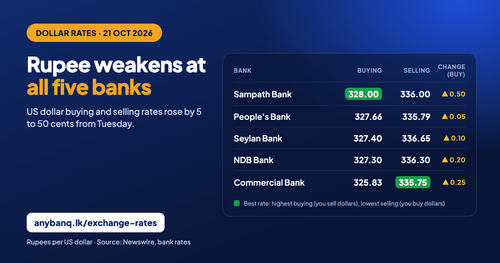
Rupee slips to 331.90/332.05 per US dollar as bond yields ease
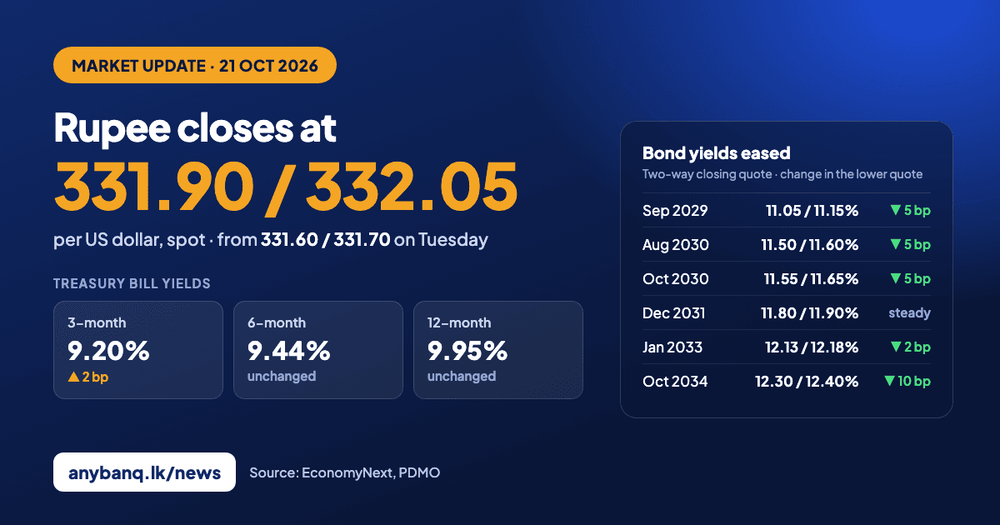
The Sri Lankan rupee ended Wednesday, 21 October 2026, a little weaker at 331.90/332.05 to the US dollar in the spot market, down from 331.60/331.70 on Tuesday, EconomyNext reported, citing currency dealers. Government bond yields were steady to lower, and Treasury bill yields at the day's auction were mostly unchanged.
At a glance
- Rupee (spot): 331.90/332.05 per US dollar, about 30 cents weaker than Tuesday's 331.60/331.70
- Bond yields: lower on five of the six maturities quoted; the October 2034 bond fell the most, by 10 basis points
- Treasury bills: 3-month 9.20% (up 2 basis points), 6-month 9.44% and 12-month 9.95% (both unchanged)
- Inflation: 8.1% year on year in September on the national index (NCPI), the highest since June 2023
The rupee
The two figures in a spot quote are the rates at which dealers were buying and selling dollars between banks. Both moved up on Wednesday, so a dollar cost slightly more rupees than the day before: about 30 cents on the buying side and 35 cents on the selling side.
These are interbank rates. The rate you get at a bank counter or on a remittance is set by each bank and includes its margin, so it will differ. Our exchange rates page shows the Central Bank's indicative rates, with links to each bank's own published rates.
Government bond yields
Dealers quoted the following two-way yields at the close. When yields fall, bond prices rise. The only move up was on the December 2031 bond, where the higher quote rose by 2 basis points.
- Bond maturing 15 Sep 2029: 11.05/11.15%, from 11.10/11.15%
- Bond maturing 1 Aug 2030: 11.50/11.60%, from 11.55/11.63%
- Bond maturing 15 Oct 2030: 11.55/11.65%, from 11.60/11.65%
- Bond maturing 1 Dec 2031: 11.80/11.90%, from 11.80/11.88%
- Bond maturing 15 Jan 2033: 12.13/12.18%, from 12.15/12.20%
- Bond maturing 15 Oct 2034: 12.30/12.40%, from 12.40/12.50%
Treasury bill auction
At Wednesday's auction the government sold Rs 80.61 billion of Treasury bills out of Rs 100 billion on offer, according to Public Debt Management Office data. Investors put most of their money into the shortest bill.
- 3-month: 9.20%, up 2 basis points. Rs 70.39 billion sold, against Rs 40 billion offered.
- 6-month: 9.44%, unchanged. Rs 3.92 billion sold, against Rs 35 billion offered.
- 12-month: 9.95%, unchanged. Rs 6.29 billion sold, against Rs 25 billion offered.
The 6-month and 12-month bills remain available on tap, meaning the government is still selling them after the auction.
What it means for you
- Money from abroad: a weaker rupee means each dollar you receive converts to slightly more rupees. On US$1,000, Wednesday's move is worth roughly Rs 300 to Rs 350. It works the other way for anything you pay for in dollars, such as imports, travel or overseas fees.
- Savings: Treasury bill yields of 9.20% to 9.95% compare with national inflation of 8.1% in September, so the return after inflation is roughly 1 to 2 percentage points a year, before tax. If you are weighing bills against a fixed deposit, compare the same term and check fixed deposit rates across banks.
- Loans: government bond and bill yields are the benchmark that bank lending and deposit rates tend to follow over time. A single day's move will not change your loan rate.
Sources: EconomyNext market reports of 21 October 2026 (rupee and bond yields from currency dealers, Treasury bill auction results from the Public Debt Management Office, and NCPI data from the Department of Census and Statistics). AnyBanq is not affiliated with these organisations. This article is for information only and is not investment advice.